
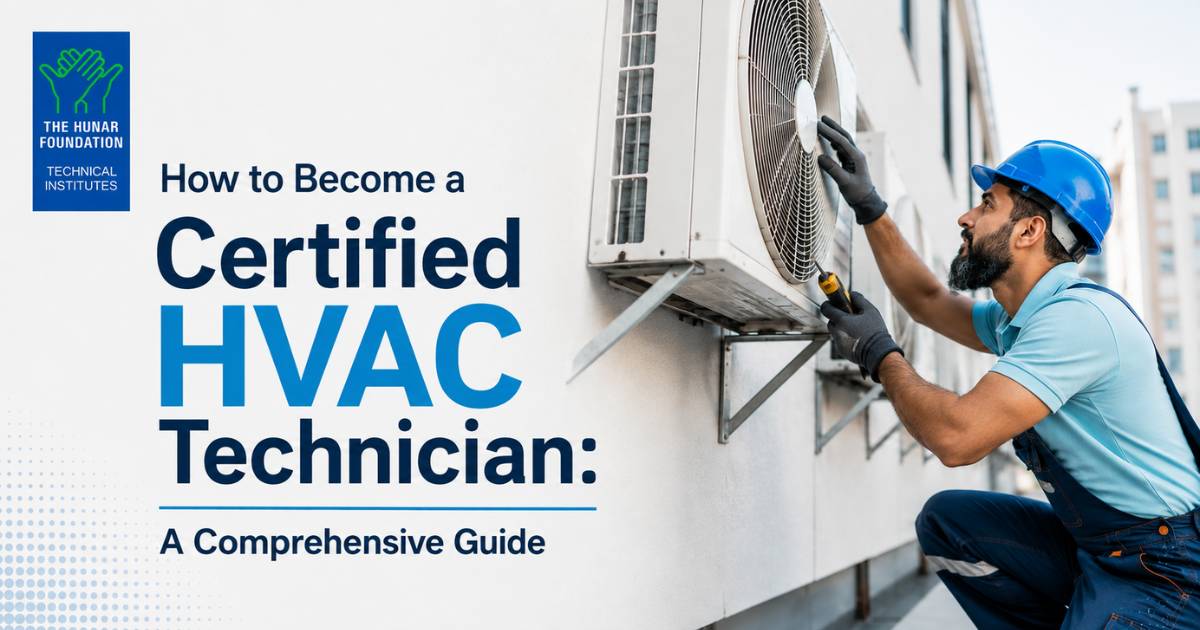
An HVAC technician repairs, installs, and maintains air conditioning and refrigeration systems. These systems run in homes, offices, malls, hospitals, hotels, factories, and shops. In Pakistan, this skill can help young people start earning through practical work. Many students choose an HVAC Technician course in Pakistan because it gives them job-ready skills in less time.
At The Hunar Foundation, we help students from underprivileged backgrounds learn useful skills, find work, and support their families. This guide explains the training path, salary, tools, job scope, and THF’s NAVTTC-certified HVACR course.
What Is an HVAC Technician?
An HVAC technician works with heating, ventilation, air conditioning, and refrigeration systems. In Pakistan, most Heating, Ventilation, and Air Conditioning work focuses on AC systems, commercial cooling, refrigeration units, chillers, and cold storage systems.
HVAC technicians install new systems, check for faults, repair parts, and maintain machines. Their work keeps buildings cool, safe, and comfortable. They also help businesses protect food, medicines, and other temperature-sensitive items.
Why Become an HVAC Technician in Pakistan?
Pakistan has hot weather for many months. Because of this, homes and businesses depend on air conditioning and cooling systems. This creates regular work for trained Heating, Ventilation, and Air Conditioning workers.
A skilled technician can find jobs in companies or earn through private service work. With experience, an HVAC technician can also grow into a supervisor, contractor, or Gulf job candidate.
High Demand in Karachi’s Commercial Sector
Karachi has offices, malls, hospitals, factories, restaurants, cold storage units, and hotels. These places use AC and refrigeration systems every day.
Because these systems need regular service, Karachi has strong demand for trained workers. Students who search for an AC technician course in Karachi can choose this field for faster job entry.
Gulf Country Job Opportunities
The UAE, Saudi Arabia, and Qatar need trained HVAC workers. Their hotels, airports, malls, offices, and large buildings use advanced cooling systems.
Pakistani technicians with training and experience can apply for Gulf jobs. However, they need strong practical skills, discipline, and proper certification.
Salary Potential in Pakistan vs Abroad
In Pakistan, HVAC workers can start with entry-level jobs and grow with experience. Abroad, salaries often become higher because Gulf markets pay more for skilled technical workers.
HVAC Technician Salary in Pakistan
What is the salary of an HVAC technician in Pakistan? Salary depends on skill, experience, city, and employer.
Based on salary estimates from job platforms like Indeed and Glassdoor, as well as local job listings, entry-level HVAC workers may earn PKR 35,000 to 60,000 per month. Skilled technicians can earn more through commercial projects, overtime, and private service work.
Senior technicians and supervisors can earn higher salaries in hotels, hospitals, factories, malls, and maintenance companies.
Step-by-Step HVAC Certification Path in Pakistan
Step 1: Meet Eligibility Requirements
Students usually need basic education and an interest in technical work. They should understand simple reading, writing, and measurements.
This field suits students who enjoy practical work and problem-solving.
Step 2: Enroll in a NAVTTC-Affiliated HVAC Institute
A NAVTTC-affiliated institute follows national skill standards. This helps students learn properly and build employer trust.
Students in Karachi can choose THF for technical training. THF supports youth with vocational education that leads toward employment.
Step 3: Complete HVAC and Refrigeration Level 2, 6 Months
Level 2 usually builds the foundation. Students learn basic AC work, refrigeration basics, tools, safety, and repair methods.
This level helps beginners enter the field and start learning through hands-on practice.
Step 4: Pass the NAVTTC Trade Test
After training, students appear in a trade test. This test checks their practical skills and understanding.
A passed trade test helps students show employers that they can perform real work.
Step 5: Gain Field Experience, 1 to 2 Years
Field experience matters a lot in Heating, Ventilation, and Air Conditioning work. Students should work with senior technicians, contractors, or maintenance companies. This helps them understand real faults, customer handling, and commercial site work.
Step 6: Complete HVAC and Refrigeration Level 3, 6 Months
Level 3 focuses on commercial HVACR systems. This level helps students move beyond basic AC work.
In THF’s Level-3 HVACR Technician course, students learn computer operations, drawings, commercial refrigeration, and commercial air conditioning systems. They learn MS Word, MS Excel, MS PowerPoint, browsing, and printing documents.
Students also learn how to draw basic lines, circles, symbols, and electrical symbols. These drawing skills help them understand technical plans.
The course covers the installation of walk-in coolers, freezers, ice-making machines, chilled water tanks, and HVACR-related components. Students also learn fault diagnosis and repair of commercial refrigeration units.
For air conditioning systems, students learn packaged units, VRF and VRV systems, chillers, AHUs, FCUs, water pumps, cooling towers, commissioning, and Heating, Ventilation, and Air Conditioning accessories. They also learn how to repair chillers, AHUs, FCUs, pumps, and cooling towers.
Step 7: Apply for Gulf Country Employment
After certification and field experience, students can apply for Gulf jobs. Employers prefer workers who understand commercial systems and site discipline.
A student should prepare a strong CV, collect certificates, and gain work proof before applying abroad.
NAVTTC HVAC Certification Explained
What Is NAVTTC?
NAVTTC stands for National Vocational and Technical Training Commission. It works to improve technical and vocational training in Pakistan. NAVTTC-certified programs follow skill-based standards. This helps students gain training that employers can understand and trust.
Difference Between Level 2 and Level 3
Level 2 teaches basic AC and refrigeration work. It helps students start their technical journey.
Level 3 teaches commercial HVACR work. It covers larger systems used in malls, hotels, hospitals, factories, and commercial buildings.
HVAC Tools Every Technician Must Know
- Refrigerant Manifold Gauges: Technicians use manifold gauges to check gas pressure in AC and refrigeration systems.
- Vacuum Pump: A vacuum pump removes air and moisture before gas charging. This helps the system work properly.
- Multimeter: A multimeter checks electrical faults, voltage, and current. Every technician must know how to use it safely.
- Leak Detector: A leak detector helps find gas leakage. This protects the system and reduces repair loss.
Pipe Benders and Flaring Tools
Technicians use these tools to shape and connect copper pipes. Clean pipework improves system performance.
Skills Covered in an HVAC Training Course
A good AC technician course teaches both basic and commercial skills. Students learn computer use, technical drawings, refrigeration installation, AC installation, troubleshooting, and repair.
THF’s Level-3 Heating, Ventilation, and Air Conditioning course focuses on commercial systems. Students learn how to install and maintain commercial refrigeration units and air conditioning systems. This gives them stronger job readiness than basic repair training alone.
HVAC Job Opportunities in Pakistan
Pakistan needs HVAC workers in homes, offices, factories, hospitals, malls, restaurants, and hotels. An HVAC technician can work with maintenance companies, contractors, commercial buildings, or private clients. With time, technicians can start their own service work.
Where HVAC Technicians Work in Karachi
Karachi offers strong work opportunities because it has a large commercial sector. HVAC workers can find jobs in malls, hospitals, factories, hotels, restaurants, schools, and cold storage units.
This makes Karachi a strong city for students who want an AC technician course in Karachi.
HVAC Demand in UAE, Saudi Arabia, and Qatar
Gulf countries need technicians for hotels, airports, offices, malls, and large housing projects.
Pakistani workers can benefit from this demand if they have training, experience, and good workplace behavior.
HVAC Course Duration and Cost in Pakistan
Heating, Ventilation, and Air Conditioning courses in Pakistan usually take around 6 months per level. Some programs may take longer depending on the institute and course level.
Course cost depends on the institute, tools, certification, and training quality. At THF, eligible students can access supported vocational training, which helps reduce financial pressure.
Get NAVTTC-Certified HVAC Training at THF in Karachi
At THF, we train students for real work, not only certificates. Our goal is to help young people learn skills that can lead to jobs, income, and family support.
Through HVACR training, students learn commercial refrigeration, commercial air conditioning, safety, computer use, and repair skills. This gives them a strong start in Pakistan’s technical job market.
FAQs
A: Entry-level workers may earn around PKR 35,000 to 60,000 per month. Skilled workers can earn more.
A: NAVTTC certification follows national skill standards. It helps employers trust your training and skills.
A: Most HVAC courses take around 6 months per level. Students can start with basic training and then move to advanced levels, such as Level 3, for commercial HVACR systems.
A: Level 2 teaches basic work. Level 3 teaches commercial HVACR systems and advanced repair skills.
A: Yes, Pakistan needs HVAC workers for homes, offices, hospitals, factories, malls, and hotels.